Since the last update, Revision has gone from a single-scene prototype to something that actually feels like a game with structure. The big theme this time: separation, persistence, and economy. Here’s what changed.
Splitting the Game in Two
The biggest architectural change was breaking the game into two scenes: MainMenu and Gameplay.
Previously, everything lived in a single scene. The inventory screen, the combat, the death screen — all crammed together, with the Game Manager juggling pause states to fake a “menu.” It worked, but it was getting messy. The inventory UI was growing in complexity and had no business sharing a scene with wave spawners and bullet physics.
Now the flow is clean:
MainMenu                          Gameplay
┌─────────────────┐   "Start"   ┌──────────────────┐
│ Loadout / Stash  │ ──────────> │ Combat / Waves   │
│ XP & Coins       │             │ Tab Inventory    │
│                  │  death or   │ Game Over        │
│                  │ <────────── │ Level Complete   │
└─────────────────┘  level done └──────────────────┘
The MainMenuManager loads your save, creates a temporary inventory for the loadout screen, and hands everything off to the Gameplay scene when you hit “Start Level.” When a game ends — whether you die or clear all waves — everything saves and you’re sent back to the menu to rearrange your loadout for the next run.
One thing I got wrong initially: when transitioning back to the menu, all items were being dumped into the stash. Your carefully arranged loadout would scatter. Fixed that quickly — items now stay exactly where you put them. Your slot 1 pistol is still in slot 1 when you come back.
The Coin Economy
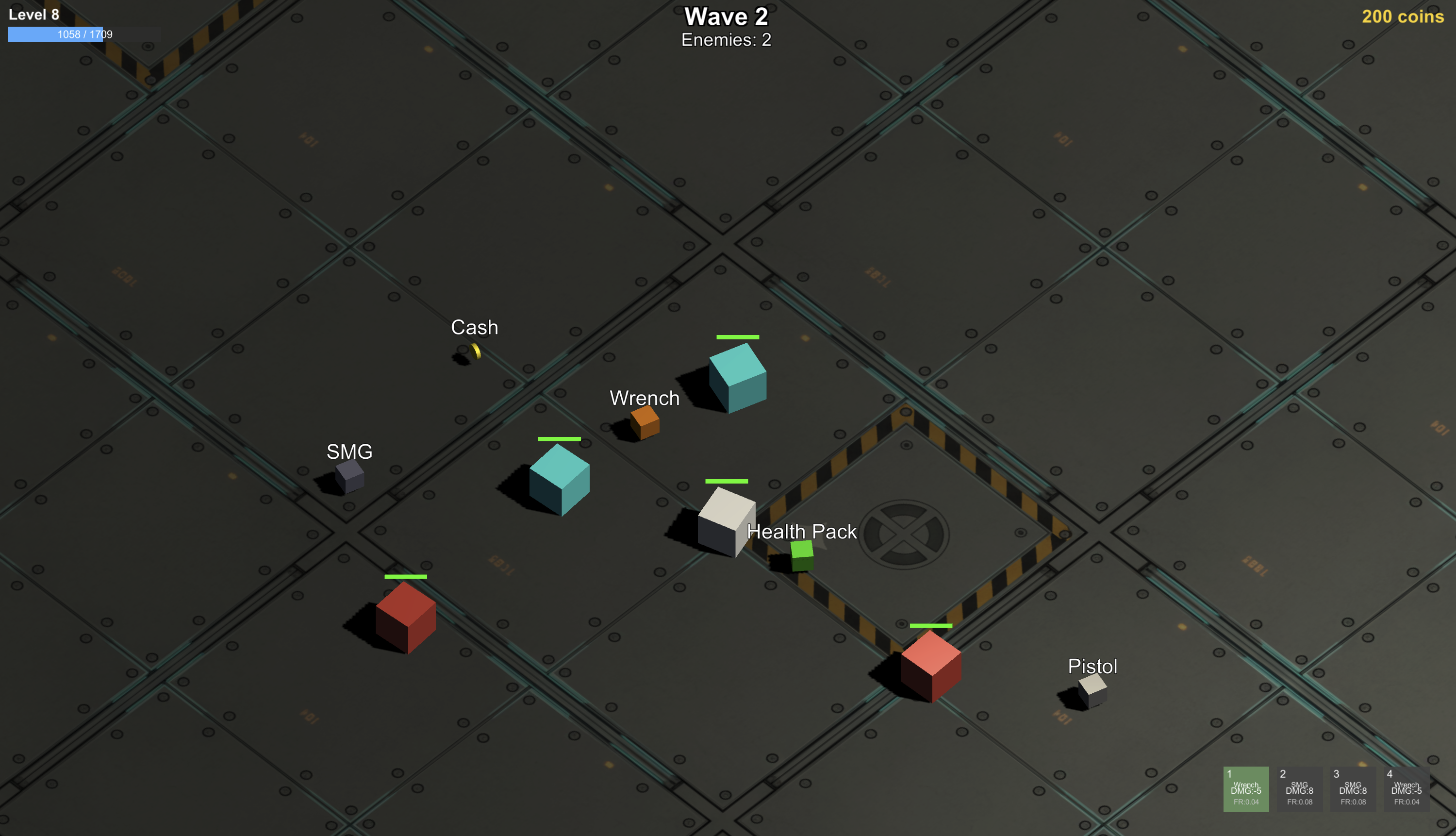
Money pickups existed before, but they literally just logged to the console. Now there’s a real CoinSystem — a singleton that tracks your coins, persists them in the save file, and never resets. Coins are tied to your character forever.
The UI sits in the top-right corner: a simple gold number that updates when you pick up cash. Money items got a visual upgrade too — they’re now upright spinning yellow cylinders instead of generic cubes, so they actually look like coins on the battlefield.
Every game now guarantees at least one money spawn, alongside the usual pistol, SMG, and wrench pickups.
The spending part comes later — but the foundation is there. Coins persist across deaths, across levels, across sessions. When the shop arrives, you’ll have something to spend.
Every Item Has a Price
Speaking of economy: all items now carry a sell value. This flows through the entire system — from pickup to inventory to save file.
| Item | Sell Value |
|---|---|
| Health Pack | 10 |
| Pistol | 50 |
| SMG | 75 |
| Wrench | 100 |
The value is stored in WeaponData, serialized in WeaponSaveData, and preserved through every drag-and-drop operation and scene transition. When selling gets implemented, you’ll be able to convert unwanted weapons into coins. The Wrench being the most valuable feels right — it’s a rare and versatile tool.
Waves That Scale With You
The wave system got smarter. Previously, wave size was a flat formula: starting size plus a fixed increase per wave. Now it factors in your character level:
enemies = baseSize + (wave - 1) * waveIncrease + playerLevelA level 1 character on wave 1 faces 4 enemies. A level 5 character on wave 2 faces 10. The game grows with you.
I also widened the enemy spawn distance dramatically — from a tight 35–50 range to 25–120 units out. This means enemies no longer arrive as a single wall. The closest ones reach you quickly while distant spawns trickle in over time, creating a more natural flow to combat. You deal with a few scouts, then the main group, then stragglers. It feels much better than everyone arriving at once.
Persistent Progression
XP and levels now properly persist across games. The experience system saves your level and current XP to the save file, and restores them when you load either scene. Die on wave 3? Your XP from those kills is still there when you retry.
The XP and coin displays show on both the main menu and in gameplay, so you always know where your character stands.
Small Fixes That Matter
A few quality-of-life improvements that don’t deserve their own section but made a real difference:
- Inventory UI background made transparent — the old dark overlay made sense when it sat on top of gameplay, but on the dedicated menu scene it just looked like a weird box over nothing
- XP and Coin displays render above the inventory — they were getting hidden behind the loadout screen, fixed by bumping their canvas sort order
- Item labels don’t get squished on coins — unparenting the label from the coin mesh prevents the non-uniform scale from distorting text
What’s Taking Shape
Revision is starting to feel like it has a real structure now. There’s a place to prepare (the menu), a place to fight (gameplay), and a reason to care about what you bring (item values, coin economy). The loop of “gear up, fight, collect, return” is working.
Next on my mind: actually spending those coins. A shop in the main menu, maybe upgrades, maybe new weapon types to buy. The systems are all there waiting — the coin balance persists, items have values, and the menu is the perfect place for a storefront.
But that’s for the next evening session. For now, I’m happy with where things are.
Built with Unity 2022.3 LTS. All gameplay systems written in C#. AI-assisted development with Claude Code.